
Editing, Leadership, and Team Building
Leadership positions
I've held positions as the Opinions Editor (first and second years on staff) and Editor-in-chief (third/current year).
As Opinions Editor, I reviewed every opinion article, ensured that people wrote them regularly so that the section was consistently updated, provided edits and in-person feedback and helped people come up with ideas. I was also responsible for ensuring that the Opinions section in the printed newspaper was complete. Of course, I love writing opinions (which is why I ended up as editor for that section), so I also filled in gaps by writing stories myself when we didn't have any going up. My first year on staff, we only had 13 writers, but our issues were 16 pages (each of which tended to have spots for multiple stories), so we sometimes ended up with blank spaces in the opinions section. In one such case, I wrote this story on club requirements, which also saved us when we were missing a story to post one night!
As a senior, I took over the Editor-in-chief position. The editors during my first two years on staff set an amazing example, so I knew that: A) I was already part of a staff with high standards for writing and publishing, and B) I had big shoes to fill. My first priority was to maintain the excellence that we already had, and my second was to diversify the types of content that we produced and make the class more enjoyable to the people on staff. We've had issues in previous years with our retention rate (which is understandable—producing quality content requires hard work and a lot of time), so I wanted to create an environment that people wanted to return to. I act as a Teacher's Assistant for my adviser during a separate class period, so I do most of my work on story-writing during that class, and spend the designated newspaper class talking with staffers one-on-one to make sure that they can manage the workload and that their stories are on track to be finished on time.
Conferences and workshops
I have attended the Florida Scholastic Press Association District 3 Fall workshop every year that I've been on staff. The first year, I was excited to go to all the different sessions, meet and learn from all of the experts, and speak with students from other staffs about how they operated and what worked for them. I returned feeling like a much wiser writer, and filled with ideas to implement throughout my time on newspaper staff.
The next year, I hosted a session on multimedia along with my fellow staffer Holly (our current Online Editor). The two of us had co-hosted a podcast the previous year and were working on a video series together, so we decided to share what we had learned since our staff was among many implementing multimedia online. In our presentation, we gave a brief overview of videos, podcasts, photo galleries, and infographics, provided tips for creating each, and explained how we incorporated them into our work.
The presentation that Holly and I gave at the 2024 FSPA District 3 Fall Workshop. It took place around Halloween—hence the spooky theme.
In 2025, I also gave a presentation at FSPA, this time about tips for staff leaders and aspiring leaders. Along with my Online Editor and Print Editor, Holly and Isabella respectively, I went over what makes a staff an enjoyable yet productive community. We were the only students giving a presentation at the conference, so we were able to connect with and relate to those in our audience more directly, since we'd experienced many of the challenges that they faced with productivity on their staff. At previous workshops, I remembered hearing a lot of student leaders ask about how we were able to consistently produce so much content while maintaining high standards, so we addressed their concerns in one big presentation and built in some time at the end for attendees to share issues they'd encountered and get feedback from us and other students. We spoke about the positions on our staff, how we structured the class for maximum productivity, how we encouraged our staff to perform at a high level, how we edited each story, our grading system, awards that we give out, and even some of our celebrations.
The presentation that I gave with my fellow editors at the 2025 FSPA District 3 Fall Workshop. We went over tips for current and future staff leaders to improve the environment and productivity of their class.
Additionally, I was among the first group of newspaper students to attend the Student Television Network conference. We went to the 2025 convention, competed in a Crazy 8s short film contest and attended numerous lecture-based sessions. This also allowed me to connect better with the TV Production staff at Hagerty, which is amazing since we've begun working with them more as we develop the Academy of Media and Communication (a program incorporating newspaper, yearbook, TV Production, photojournalism, and digital design).

Making it fun!
I ask a lot of my staff and hold them to pretty high standards, so I like to make their time working as enjoyable as possible.
We have a bell in our classroom, and every time we accomplish something (usually posting a story or winning an award), we ring the bell. My teacher installed it last year, but it's one of my favorite traditions to carry on. At the beginning of every class, me or Holly, the Online Editor, will read off the names of everyone who posted a story or won an award in the past day.


"Press days" (or really "press week" at this point) is another great opportunity for team building and fun. On these days, we meet in the newspaper classroom after school and work on designing pages for a print issue. Since press days can be exhausting, I like to implement dress-up themes to keep everyone's spirits up. I also make sure to greet everyone and thank them for their time--it seems small, but I want everyone to feel welcome and appreciated at all times.
Communication
GroupMe
We mostly communicate through the app GroupMe, for everything from scheduling press days to asking for edits. If we go over something important in class, I also post it in GroupMe to make sure that everyone gets the message and has a reminder. I also encourage people to reach out one-on-one if they have individual questions, either through private messages on GroupMe or with my phone number. I don't want to clutter our main group chat too much (both because excessive notifications are annoying and because too many messages can cause people overlook important information), so I make my communication as concise as possible, often address multiple people in the same message, and start conversations in smaller groups or one-on-one if I have a lot to say or need to go into more detail.


Something that has frustrated me in the past in other groups is when leaders don't respond or take a lot of time to respond. I've spoken with the other two main editors, Holly and Isabella, about this, and we've made a conscious effort to respond to messages as soon as possible--usually within an hour of receiving them.


Interviews
After the first semester of the year, I sat down with every single member of the staff except for the other two editors, and interviewed them on how the year had been going so far. I asked what they liked about the class, how the workload was for them, what they wanted to change, how we could improve in future years, if there was anything specific they were struggling with, whether they wanted more or less direct editor involvement in their writing process going forward, if they had any ideas to improve the quality of the paper and if there was anything they wanted to address or make me aware of while we were one-on-one. I took notes from each interview, looked at the most commonly expressed sentiments and made adjustments going forward based on what they said.
"Teaching" the staff
Partner stories
Starting off the year, about half of our staff was new to writing for the paper. Several of them expressed that they felt lost or overwhelmed at the idea of joining newspaper, and I didn't want to throw them into writing without any guidance. However, we also needed to start publishing stories as soon as possible and didn't have time to teach them the entire curriculum's worth of AP style, story structure, persuasive vs. informative writing, interviewing skills, photography and website navigation that they would need in order to independently write and publish a single story. In order to get around this issue, I divided everyone on the staff into pairs of one newcomer and one returning staffer, and had them write partner stories about an assigned topic. This worked out really well, as we got a lot of stories written and published on time during the first two weeks of school, new people experienced the entire story-writing process from start to finish, returners got to develop their leadership/communication skills by teaching someone new and people on the staff got to know each other by collaborating on a story. We even got our first "Best of SNO" for one of these stories!
Guides and references
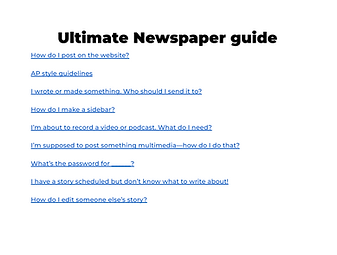
I made a 29-page "Ultimate Newspaper Guide" to address questions that people on staff asked frequently. Of course, I'm always willing to help them out or answer their questions in person, but if they wanted a reference for AP style or a guide to editing to work off of, or I wasn't available to help, this Doc is always there.


I also created a list of "stock questions" for sports interviews, which has been helpful for reporters who don't know much about the sport they're covering or have never written for this category before. Obviously, I'd also like them to write some of their own questions and come up with follow-ups as they interview, but these are all things that will help them write a better story and get information that they will inevitably need as they write.

Technical skills and software
Over the years, I've become proficient in a lot of software, including several Adobe programs, and I love teaching other people about them. It's super exciting to see people take initiative and want to do things like create a video or podcast, so I'm always glad to help them out with Premiere, Audition, Photoshop, and more.
At one point, a staff reporter, Michelle, was writing a story about different students' senses of humor, and to go along with her story, she planned to make a video in which she walked around campus, asking students for their favorite jokes. I was working on a news video at the same time, so I showed her how to edit the video using Premiere Pro by walking her through the steps I took to organize and import footage, cut clips, add audio and export the final product.

Michelle's video for the story "Humor me." I acted as camera operator and showed her how to use Premiere Pro.
I also taught the Foundations of Journalism class (a class in which students learn the basic skills for newspaper, yearbook and photography) how to record and edit podcast audio using the microphones and recording setup we had as well as Adobe Audition, which is a fairly advanced software.
I teach the Foundations of Journalism class the basics of Audition. I enjoy showing others how to use software that I'm familiar with.


Editing staff content
I take the "teach a man to fish" philosophy very seriously in my editing. Certainly, we would publish well-written, grammatically correct stories if I simply corrected every error without explaining, but the people writing them wouldn't grow as reporters, and after I graduate, they would struggle to operate independently. Instead, I take the time to explain why certain phrasing, spelling or abbreviations are wrong or right, in the hopes that each person on staff will end the year a better writer.
On the BluePrint staff, our writing/editing process goes like this:
-
Pre-plan: The angle is decided, interview questions are written and the reporter has a plan for any photos or multimedia they will need. For bigger ("enhanced") stories, the reporter needs to pitch the article to me and at least one other editor.
-
Plan: The reporter has interviews, in some cases an outline, research and a solid idea of what they are going to write. This is a crucial point for me to check in, since they should be able to write the entire story with information from the plan.
-
Rough: The story is written. This is where me and a few other editors give most of our edits.
-
Final: The story is finished and has been edited. I always look over the final draft one more time before it posts on the website. I don't make major edits at this stage (since they should have been made to the rough), just grammatical corrections and an overview to make sure that everything still makes sense after all the previous changes.
We do all of this on Google Docs, using the comment and suggestion features, so that the writer can see our edits and decide for themselves if they want to make them and how.
Click on the images in the gallery below to see examples of my editing!


Contests and awards
It's easy to underestimate the significance of entering contests, but I've found it to be greatly successful in team-building and improving how our staff interacts with each other. When one person wins, we all celebrate for them.
Every single day that "Best of SNO" is open for submissions (even over breaks), either Holly, the Online Editor, or I submit a story, even if we doubt whether it will actually win anything. Giving our staff as many chances as possible to win means that they will feel rewarded for their hard work more often. We also print out the certificates from our "Best of SNO"s and tape them to the wall of the classroom as encouragement.

The "Best of SNO" wall in our classroom. This is a great way for us to celebrate our staff's achievements, and give them something to strive for.
I also enjoy entering FSPA contests, so I work with other students as often as possible on them, and give them a chance to join as well. This year, I worked with three other staffers to create a short film for FSPA, and not only did it give us a chance to develop a different kind of technical and creative skill, it was a great exercise in teamwork, and watching the filming process and end product kept up morale during our press week.
The short film I wrote with a few other staff members. Projects such as this one can be a great team-building exercise, and leave us with a product we're proud of.
At the end of each issue, we also give out issue awards, which recognize the people who worked hard, gave us a lot of their time or just did something super impressive for the print issue. State and national organizations may not give out awards for staying after school for five hours and helping out in little ways with every single page, but I want staff members to feel appreciated when they contribute to a product that turns out really well.